
The Importance of UI UX Design for Business Success
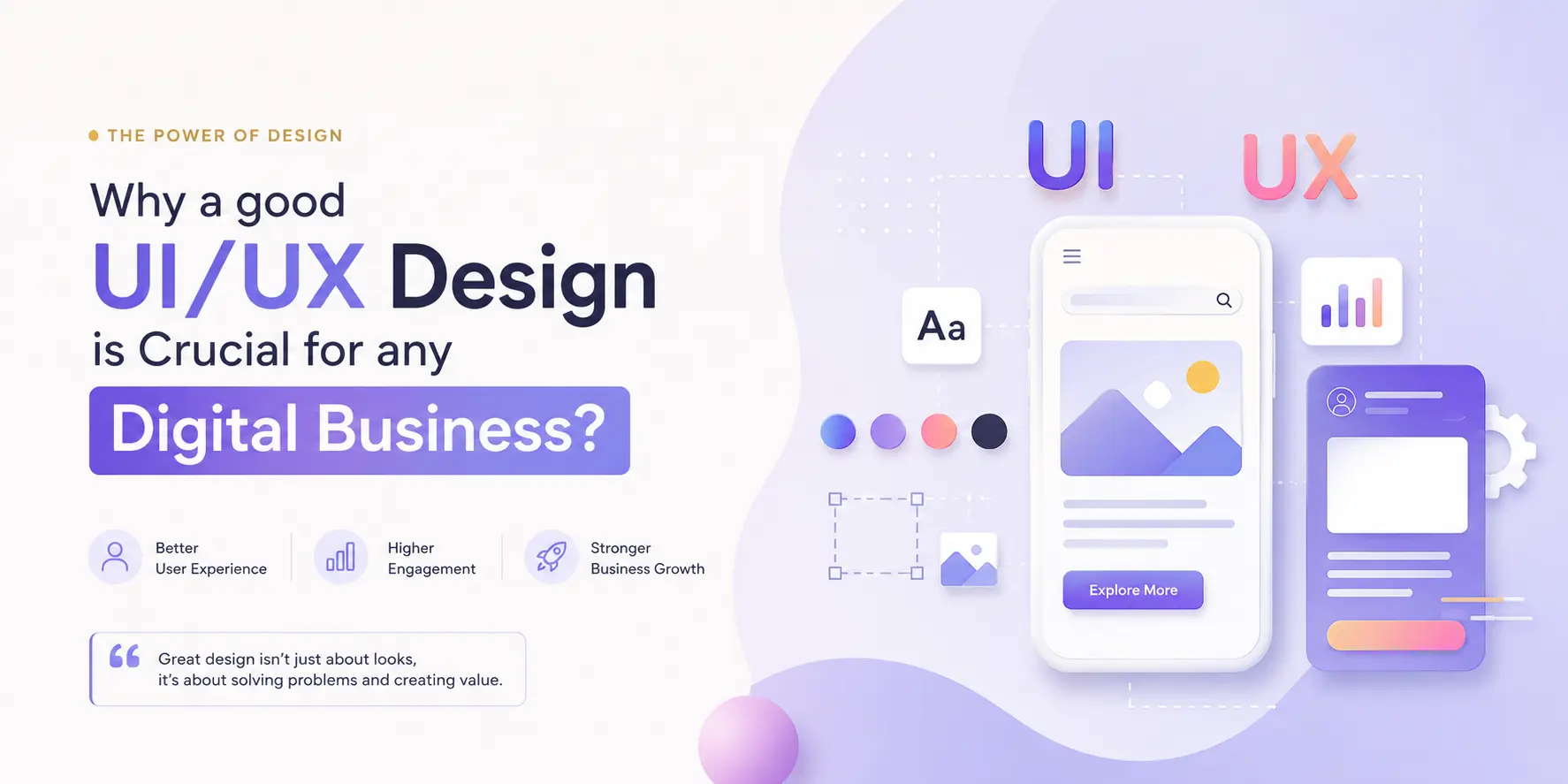
Understanding the Impact of UI UX Design on Business Success
In today's digital environment, businesses work hard to provide customers with an engaging user experience. UI (User Interface) design and UX (User Experience) design are pivotal in achieving this goal. UI UX design services have become critical for businesses seeking to enhance customer satisfaction, boost brand loyalty, and gain a competitive edge. In this article, we will look at the significance of UI/UX design services and how they can benefit businesses, particularly small enterprises.
Interesting Facts on UI UX Design:
- After a negative user experience, 88% of online shoppers are less likely to revisit the same website. (Source: Econsultancy)
- Well-designed user interfaces can increase conversions by up to 200%. (Source: Forrester Research)
- Companies prioritizing UX design outperformed the S&P 500 index by 228% over a 10-year period. (Source: Design Management Institute)
What is UX Design?
User Experience (UX) design is the process of elevating customer satisfaction by enhancing a product or service's usability, accessibility, and general user-product interaction. It focuses on understanding user needs, goals, and behaviors to create intuitive and enjoyable experiences.
Elements of UX Design:
UX design encompasses several key elements that contribute to creating a delightful user experience. Let's explore these elements and understand their significance in the UX design process.
- User Research: User research is the cornerstone of UX design. It involves gathering valuable insights about user behaviors, needs, preferences, and pain points. Designers gain a deeper understanding of the target audience through surveys, interviews, and user testing. This information helps create user-centered designs that address specific user needs and expectations.
- Information Architecture: Information architecture focuses on organizing content and navigation to ensure logical and intuitive user flows. It involves structuring information, categorizing content, and creating hierarchical relationships between elements. A well-designed information architecture facilitates efficient navigation, making it easier for users to find what they are looking for, reducing frustration, and enhancing the overall user experience.
- Wireframing and Prototyping: Wireframing and prototyping are essential steps in the UX design process. Wireframes are simplified visual representations of the user interface, showcasing a digital product or website’s layout, structure, and basic functionalities. They act as a template for the design and allow designers to test and refine the concept before continuing. Conversely, prototypes are interactive design versions that simulate user interactions and provide a more realistic experience. By creating wireframes and prototypes, designers can gather feedback early in the process and make necessary adjustments to enhance usability and user satisfaction.
- Interaction Design: Interaction design defines how users interact with the product or interface. It aims to create user-friendly and intuitive interactions that smoothly guide users through their tasks. Interaction designers consider factors like visual feedback, micro-interactions, user flow, and gestures to ensure a seamless and enjoyable experience. By carefully designing the interactions, designers can enhance usability, engage users, and create positive emotional responses.
- Usability Testing: Usability testing involves evaluating the design with real users to identify areas for improvement. It offers insightful information on how users engage with the interface, where they have trouble, and which elements of the design work well. Usability testing helps designers validate their design decisions, identify pain points, and make data-driven improvements. By incorporating user feedback, designers can refine the user experience and create more intuitive and user-friendly designs.
UX design elements work together to create exceptional user experiences. User research provides insights into user behaviors and needs; information architecture ensures intuitive navigation; wireframing and prototyping enable testing and iteration; interaction design enhances user interactions; and usability testing validates the design and identifies areas for improvement. By incorporating these elements into the UX design process, businesses can create products and services tailored to user needs, resulting in higher user satisfaction, engagement, and, ultimately, business success.
What is UI Design?
The visual elements of a product or service, including the look, feel, and overall aesthetics, are the primary emphasis of user interface (UI) design. It involves crafting visually appealing interfaces that facilitate smooth and engaging interactions.
Elements of UI Design:
Let’s explore the key UI design elements and understand their importance in crafting effective and visually appealing interfaces.
- Layout and Composition: Layout and composition involve organizing elements on the screen to create a balanced and visually pleasing design. A well-structured layout ensures that information is presented in a logical and organized manner. It involves considering factors such as spacing, alignment, and placement of elements to create a visually unified interface that guides users through the content.
- Typography: Typography plays a crucial role in UI design as it involves choosing appropriate fonts, sizes, and styles to enhance readability and establish a consistent brand identity. The right typography enhances the overall visual appeal of the interface, makes the content more legible, and creates a cohesive and recognizable brand image.
- Color and Contrast: Color and contrast are potent tools in UI design that can evoke emotions, guide user attention, and create a visual hierarchy. Designers can use color psychology to influence user perceptions and create a specific atmosphere or mood. Contrast is essential to distinguish between different elements and establish a visual hierarchy. It helps users navigate the interface and focus on important information.
- Visual Hierarchy: Visual hierarchy involves structuring content to prioritize important information and guide users through the interface. Using visual cues such as size, color, contrast, and placement, designers can direct user attention and help them understand the relative importance and relationships between different elements. A compelling visual hierarchy ensures that users can quickly and easily find the information they need, enhancing usability and user experience.
- Responsive Design: With the increasing use of various devices and screen sizes, responsive design has become a crucial element of UI design. Responsive design ensures that the interface adapts seamlessly to different devices, resolutions, and orientations. It involves creating flexible layouts, fluid grids, and scalable elements that maintain usability and visual appeal across multiple devices. Responsive design is essential for providing a consistent and optimized user experience, regardless of the device being used.
UI design elements work together to create visually appealing and user-friendly interfaces. Layout and composition establish a well-organized structure; typography enhances readability and brand identity; color and contrast evoke emotions and guide attention; visual hierarchy shows information prioritization; and responsive design ensures a consistent experience across devices. By incorporating these elements, UI designers can create interfaces that captivate users, facilitate easy navigation, and contribute to a positive overall user experience.
What is More Important, UI or UX?
Why is UX design important? Why is UI design important? What is more important – User experience design or User interface design?
While UI and UX design are closely related, they serve different purposes. UX design optimizes the overall user experience, while UI design emphasizes the visual and interactive aspects. Both elements are crucial and work hand in hand to create exceptional user experiences. Neglecting either aspect can result in a subpar user experience that may drive customers away. At the same time, a good ui ux design can help you gain more customers and retain the existing ones.
Why Do You Need UI/UX for Your Business Website or Application?
Good UI/UX design is crucial for businesses in today’s digital landscape. Let’s explore some of the benefits of UI/UX design and why investing in UI UX design services for your business website or application is essential for success.
- Enhanced User Satisfaction: Good UI/UX design creates positive impressions, builds trust, and fosters customer satisfaction.
- Increased Conversions: Intuitive and user-friendly interfaces can increase conversion rates, improving the bottom line.
- Competitive Advantage: In today’s crowded market, businesses must differentiate themselves. Exceptional UI/UX design sets you apart from the competition.
- Customer Retention: A seamless user experience encourages customers to stay longer, engage more, and become loyal brand advocates.
- Cost Savings: Investing in UI/UX design from the beginning helps avoid costly redesigns and development errors.
UI UX design services is essential for businesses to thrive digitally. The importance of user experience in the digital world is self-evident – It enhances user satisfaction, increases conversions, provides a competitive advantage, fosters customer retention, and helps in cost savings. By prioritizing UI/UX design services, businesses can create exceptional experiences that delight their users, drive business growth, and establish a strong brand presence.
What Advantages Does UI/UX Design Offer to Small Businesses?
Small businesses can significantly benefit from investing in UI UX design services. Let’s explore some of the trends of ui ux design and the advantages it offers to small businesses.
- Leveling the Playing Field: Small businesses can compete with larger players by offering outstanding user experiences.
- Building Trust and Credibility: Professional and user-centric designs instill confidence in potential customers.
- Better Customer Understanding: UI/UX design helps small businesses gain insights into their target audience and tailor their offerings accordingly.
- Increased Customer Engagement: Engaging interfaces increase customer interaction and encourage them to explore products and services.
- Long-Term Growth: Investing in UI/UX design establishes a strong foundation for growth, scalability, and customer retention.
UI/UX design offers significant benefits to small businesses. It helps level the playing field, build trust and credibility, gain better customer understanding, increase customer engagement, and establish a foundation for long-term growth. By investing in UI/UX design firms, small businesses can create a competitive edge, enhance customer experiences, and position themselves for success in the market.
Final Thoughts:
UI/UX design services are not mere luxuries but essential components for businesses aiming to succeed in the digital world. By prioritizing user experience, companies can create meaningful connections with their customers, increase conversions, and foster brand loyalty. Small businesses, in particular, can leverage UI/UX design to level the playing field, build credibility, and drive long-term growth. Investing in UI/UX design is a wise strategy that pays off in terms of customer satisfaction, competitive advantage, and business success.
Mobile and associated technologies are growing at an international appeal, and as technology advances, people’s expectations to spend less and get more done without problems are increasing. As a result, the importance of UI/UX design for your applications becomes even more vital.
The major reason why consumers choose mobile over desktop is because of mobile applications. In 2018, 205.4 billion mobile applications were downloaded worldwide, with that figure predicted to rise to 258.2 billion by 2022. According to the data, PC is rapidly becoming the "secondary touch-point" for a substantial portion of the internet population. People are flocking to the smartphone app due to its usefulness and capacity to do tasks swiftly.
To remain in the digital market in this era of digitization, your mobile app must face stiff competition. As a result, it’s critical for your apps to have engaging and eye-catching design services that may impact users minds. The UI/UX design development services improves the user experience and hence plays an important influence in your business success for your customers.
Let’s first get an understanding of why these experiences are the core functionalities of your product and how it’s important for your online business's growth.
Understanding User Interfaces?
The acronym UI refers to the user interface, which is the method in which consumers engage with the mobile app. All of the app's controls, buttons, blocks, and objects are part of the user interface.
The user interface's main goal is to make the interaction between the user and the program as simple, entertaining, and effective as possible. Selecting a color, corporate identity, and current design concepts are all part of the UI development process.
Understanding User Experience (UX)
User experience design is not a completely new notion in the commercial sector. Businesses have long attempted to better themselves by mapping the user experience as they progress through interactions with them. However, applying that approach to customers' digital movement is a newer development.
UX designers may improve the user experience in a variety of ways. To increase usability, they may alter interface components, page layouts, typefaces, and other factors. They may identify regions with a high volume of consumer complaints and make changes as needed. Resolving link mistakes, restructuring sites to better convey information, and including artwork to increase client interest are all examples of UX design.
What Is The Relationship Between UX And UI?
In a firm, both the user interface and the user experiences are critical. They are linked to one other in many ways. Consider the user interface as a component of the user experience to better comprehend this link.
In order to focus on a user experience, your company must integrate the user interface with its objectives. You may also think of the user interface as a method for providing the best possible user experience. As a result, everything that has a negative impact on the user interface might also have a negative impact on the user experience.
If you own a small or medium-sized business, your website may be the most important factor in your success. Your website can have an impact on the number of sales it produces. It has a lot to do with how much thought you put into your website's UX and UI. Your website can attract the attention of potential consumers and persuade them to investigate your efforts before making a final purchase choice with improved UX and UI design and development. As a result, many business people now see UI UX design services as a more lucrative option.
User experience, or UX, has evolved into the art of generating digitalized experiences for users that are entertaining, simple to use, and habit-forming. According to NelsonHall, the global market for User Experience and User Interface is worth $5300 million. It is also predicted to expand at a pace of 15.4 percent, bringing it to almost $10956 million by 2022. Therefore, it would not be incorrect to assert that excellent UX and UI design may provide several benefits to a company.
How Does Ul/UX Design Affect the Success of Your Mobile App?
Users of mobile apps choose applications that are simple to use and more interesting. The most popular apps, such as WhatsApp, have consistently provided their users with easy navigation and an appealing UI. The first step in having a successful application is to create one with an effective Ul/UX design. This is due to the fact that most app users choose a visually beautiful and user-friendly app over one with strong functionality but a less appealing design.
When people use your software, a great interface provides them a genuine experience. It also ensures that they have access to a steady stream of useful information. As more people get interested in your app, natural traffic will emerge. This will result in a rise in conversion rates and, as a result, the growth of your brand name. As a result, it's critical to engage an expert Ul/UX designer to ensure that your mobile app is engaging and enjoyable for your consumers.
Why Is Ui/Ux Design Important For Business Development?
Now it's time to get down to business...
Because UI and UX Development focus primarily on customer happiness and enjoyment, it is critical to a company's success. In order to establish a business's brand value and reputation, it is critical to focus on the users' pleasure. Given the competitive nature of the IT industry, the requirement for UI UX design services to capture customers' attention and generate income from the company's goods is critical.
It is your and your UI UX Developers' obligation to lead customers to their predefined objective in the most effective way possible while they are surfing your websites or using your applications. As a result, UI and UX design development services have become an important aspect of today's online development.
When Should You Update Your UI/UX?
The UI/UX design of software and apps aids in improving consumer happiness and experience. This, in turn, aids in increasing the number of individuals who use your goods. Users are more likely to abandon your product if they run across hurdles when attempting to finish tasks.
A clean and straightforward interface saves consumers time and confusion by eliminating the need to seek for the proper button to click. You want them to be able to effortlessly explore the product and complete their task fast.
This is especially crucial, but difficult to execute when your product is continually being updated with new features. You must organize and prioritize the functions to display in order to retain a "minimalistic" appearance. Is it possible to conceal some elements? What is the order in which the actions are performed?
When faced with technical advancements, another apparent reason to update your product design is to keep up with the times. For instance, when Flash was no longer relevant. Also, when people began to move away from desktop computers and toward mobile devices.
According to research, you have fewer than 10 seconds to capture the attention of online clients. As a result, you must exhibit exceptional design and experience. The same is true of SaaS providers that provide free trials. Your product must persuade buyers that it offers value and solves issues in a short amount of time. You don't want to waste the time and money you put into recruiting these new consumers.
Recommendation: 7 Important Ways to Secure Your Business Website
Let’s discover what the market predicts for each experience counted on your web or mobile application.
Understanding Your Customers' Needs
Understand what’s important and what's ruling the attention of your customers.
Defining UI/UX Success Metrics
The absence of performance statistics is one of the reasons why corporations don't value UI/UX design. How do you persuade the board that a new UI/UX makes a difference if you don't have proof to back it up? As a result, defining quantifiable goals and KPIs for your UI/UX design projects is critical.
Here are few areas to investigate for your success metrics:
Architecture of Information
Creating user flow diagrams necessitates a considerable degree of reasoning. Is the flow of the displays logical? What should the feature hierarchy look like? There may not even be an absolute solution most of the time. User testing, on the other hand, can help you choose the "best" technique.
Test a couple different wireframes with your users and compare the results. Metrics like job completion rate, task time, and ease of use ratings may help you quantify and compare the findings so you can construct a better design.
Usability
A crowded user interface might make it difficult to know what to do or where to click. However, mastering the skill of "where to place something" is difficult. Unfortunately, designers' and product managers' "sixth sense" is not always correct. (I mean no disrespect!)
User acceptability testing may assist you to figure out if your designs are usable and successful. We tested where to put buttons, what the language on the button should say, and what icons to utilize during the development process.
There was a section labeled "Open Tickets" to offer you a more specific example. We questioned consumers "How much input is not handled in this project?" to make sure the content was intelligible. We knew the users' understanding gap was ideal when the majority of the testers were able to correctly answer the question.
Outward Appearance
The product's and website's aesthetic attractiveness can have an impact on the customer's view of the brand. Choosing a certain blue above other colors resulted in an extra $80 million in annual income for Bing, according to Microsoft's A/B testing.
The number of additional clicks on adverts and enhanced user engagement may be used to quantify and calculate visual effects. You may use such evidence to guide your decisions and show the board how the new design helps the company's success.
Ux Is A Necessity
Having a UX designer or team for a website is becoming a must-have as more firms learn about the benefits of UX design and its best practises become more known. Businesses who do not include UX into their digital presence may lose clients to competitors that have more usable and trustworthy websites.
Offshoring UI/UX designer services for hire are becoming more common than they have been in recent years, which is a good thing. More people who previously just knew and comprehended some components of website design have broadened their horizons and developed the ability to handle UX design.
Businesses are also learning how to form dedicated UX research and development teams or divisions. These groups may make significant improvements to a company's digital presence while generating high returns on investment.
Even small businesses should be able to recruit UX designers or teach some of their current employees to fill these jobs in near future. This will enable them to remain competitive in the digital realm, at least in terms of advantages. They will be able to prevent typical blunders, reduce their assistance demands, build client trust, and improve their overall performance.
Conclusion
The user interface and user experience (UI/UX) of your mobile app is critical. You must create an exceptional user interface and user experience in order for your app to be successful. You can make your app more interactive and engaging by understanding your target audience's needs and market preferences.
Feel free to contact us at any time if you have any questions or would want us to assist you in creating UI/UX for your mobile application. We would be delighted to assist you!
For expert help in creating an exceptional UI/UX design for your mobile application, consider reaching out to Chulbul Design.
Frequently Asked Questions
What is UI/UX design?
UI/UX design refers to the process of creating user interfaces and user experiences for digital products, such as websites and mobile applications. It involves understanding the needs and preferences of the target audience and designing interfaces that are intuitive, interactive, and engaging.
Why is UI/UX design important?
UI/UX design is important because it can make or break the success of a digital product. A well-designed UI/UX can improve user engagement, increase conversions, and enhance the overall user experience, while a poorly designed UI/UX can lead to frustration, confusion, and a negative experience.
How can I improve my UI/UX design skills?
There are several ways to improve your UI/UX design skills, including taking online courses, attending design workshops, and practicing with real-world projects. You can also learn from other designers by studying their work, reading design blogs, and participating in design communities.
What are some common UI/UX design mistakes?
Some common UI/UX design mistakes include cluttered and confusing interfaces, poor navigation, and inadequate feedback. Other mistakes include ignoring user research, not testing designs with real users, and failing to consider accessibility and usability issues.